Thanksgiving dinner calories: what a typical plate adds up to
A typical Thanksgiving plate with pie comes to about 1,135 calories by USDA data. See the sum item by item, what moves it, and how to log the day calmly.
On this page
- How many calories are in a Thanksgiving dinner?
- What does a typical Thanksgiving plate add up to?
- Why this is an example, not an average
- What moves the number most?
- Does one big meal matter?
- How to log Thanksgiving without the stress
- A note on holiday meals and tracking
- Where does Getfiit fit?
- Frequently asked questions
- Your next step
A typical Thanksgiving plate, turkey, stuffing, potatoes, gravy, green beans, cranberry sauce, a roll and a slice of pumpkin pie, adds up to about 1,135 calories by USDA food data. Without the pie it is about 812. Your plate will differ, because portions and recipes do.
Thanksgiving is Thursday, November 26, 2026. This page does the arithmetic in public, so you can see where the calories sit and which choices move the number. It is not a verdict on the meal.
Key takeaways
- One plate built from standard portions comes to about 1,135 calories with pie, and about 812 without it. We chose the plate, so it is an example, not an average.
- Pie, turkey with skin, stuffing and cranberry sauce make up most of it. Gravy and green beans barely register.
- The biggest swings come from portion size, butter and a second helping, not from any one food.
- A 2000 NIH study of 195 adults found an average gain of 0.37 kg over the holiday weeks, so one dinner is not the whole picture.
- You can log the day in one message and keep going. Log the meal, enjoy it, and have a normal Friday.
How many calories are in a Thanksgiving dinner?
For the plate below, the total is about 1,135 calories, or 812 without the pie. That is one plate.
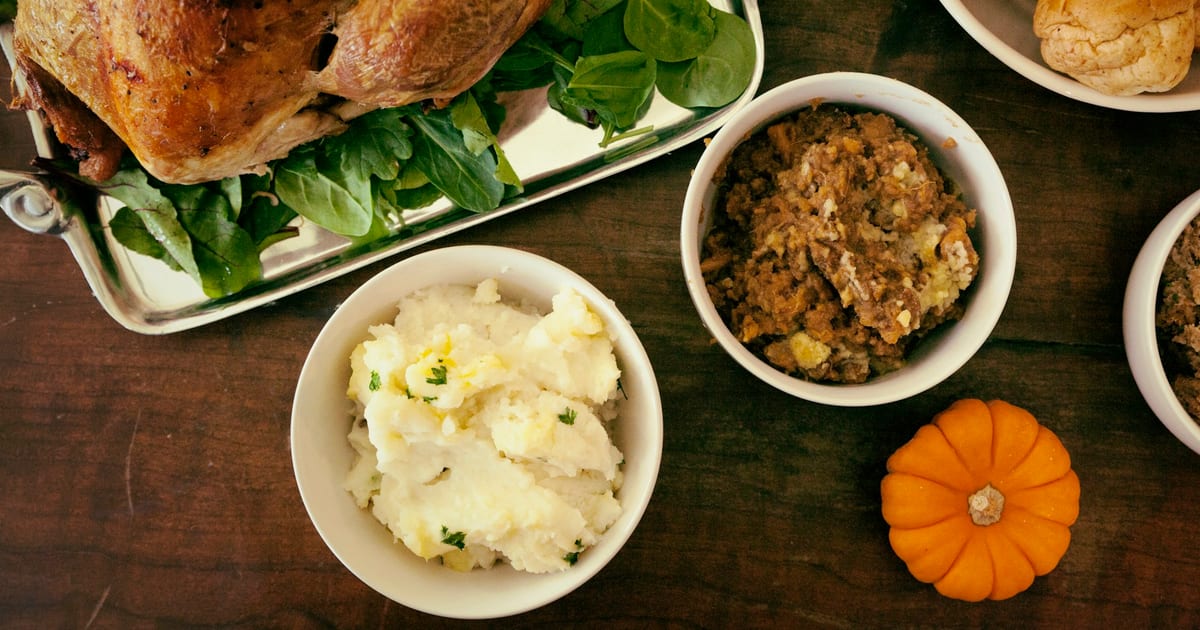
We picked the foods and the portions. They are common ones: 4 oz of roast turkey, half a cup of stuffing, half a cup of mashed potatoes, a ladle of gravy, a few green beans, a spoonful of cranberry sauce, a roll with a pat of butter, and one slice of pumpkin pie. Every calorie figure comes from USDA data, which is the part we can check.
The numbers come from USDA FoodData Central, the SR Legacy dataset (April 2018 release, entries published April 1, 2019). We downloaded the CSV files from FoodData Central because its API was rate limited, then read each food’s energy and macros per 100 grams, then scaled to the portion weights. The figures are as of October 2026.
What does a typical Thanksgiving plate add up to?
| Item | Portion | Weight | Calories | Protein | Carbs | Fat |
|---|---|---|---|---|---|---|
| Turkey, breast, meat and skin, roasted | 4 oz | 113 g | 214 | 32 g | 0 g | 8 g |
| Stuffing, bread, prepared | 1/2 cup | 100 g | 195 | 3 g | 19 g | 12 g |
| Mashed potatoes, whole milk and butter | 1/2 cup | 105 g | 119 | 2 g | 18 g | 4 g |
| Turkey gravy, canned | 1/4 cup | 60 g | 30 | 2 g | 3 g | 1 g |
| Green beans, boiled | 1/2 cup | 63 g | 22 | 1 g | 5 g | 0 g |
| Cranberry sauce, canned | 1/4 cup | 69 g | 110 | 1 g | 28 g | 0 g |
| Dinner roll, plain | 1 roll | 28 g | 87 | 3 g | 15 g | 2 g |
| Butter, salted | 1 pat | 5 g | 36 | 0 g | 0 g | 4 g |
| Pumpkin pie, commercially prepared | 1 slice | 133 g | 323 | 5 g | 46 g | 13 g |
| Plate total | 1,135 | 49 g | 133 g | 45 g |
The total is added before rounding, so it can differ from the rows by a gram or a calorie. Without the pie, the plate is about 812 calories, 44 g of protein, 87 g of carbs and 32 g of fat.
Here is where the calories sit:
The pie is the largest single item, at about 28 percent of the plate. Turkey is the next biggest, and it is also where most of the protein comes from.
Why this is an example, not an average
Be careful with any page that tells you the calories in “a” Thanksgiving dinner. The number depends on three things we can’t see from here.
- Portions. Half a cup is a modest scoop. A heaping serving spoon of stuffing or potatoes is usually more.
- Recipes. The stuffing entry is bread stuffing prepared from a dry mix. A homemade version with sausage, extra butter or broth can come out higher or lower.
- What isn’t on the plate. Appetizers, drinks, a second helping and the leftovers eaten at 10 p.m. all count, and none is in the sum.
Two items also stand in for something else. The database has no entry for green bean casserole, which is made with cream soup and fried onions, so the plate uses plain boiled green beans. If you eat the casserole, that line will be higher. We also left out sweet potatoes and wine, which many tables add.
What moves the number most?
Small choices matter less than you might expect, and a few matter more. Using the same USDA entries:
| Change | Calories | Why it matters |
|---|---|---|
| Turkey without the skin (4 oz) | about 48 fewer | Meat only is about 166 calories against 214 with skin |
| A second 1/2 cup of stuffing | about 195 more | The same scoop again doubles that line |
| One extra tablespoon of butter | about 102 more | Butter is about 717 calories per 100 g, and a tablespoon is 14.2 g |
| Double the gravy (1/2 cup) | about 30 more | Gravy is lighter than it looks |
| Skip the pie, or share a slice | about 323 fewer | The single biggest line |
The takeaway is plain. Seconds of the dense sides and butter move the total far more than gravy or green beans do. Butter is also the item a photo can’t show, which is why it’s worth saying out loud when you log. We cover that blind spot in how AI calorie counters work.
None of this is a reason to eat less or more. It is a way to see the meal clearly. What you do with it is yours.
Does one big meal matter?
For most people, less than the headlines suggest. A prospective study in the New England Journal of Medicine (Yanovski et al., 2000, PMID 10727591) weighed 195 adults at several points around the holidays. Mean weight rose 0.37 kg (about 0.8 lb) between mid-November and early to mid-January, less than the 5 lb that is often claimed.
The details matter. It was a convenience sample of 195 adults studied at the NIH in Bethesda, it is 26 years old, and the average hides a wide spread: the standard deviation was 1.52 kg, so some people gained more and some lost. The authors also reported a net gain of 0.48 kg by late February or March that had not reversed by the following fall.
We read it this way. One dinner is not the issue. The weeks around it are what shift an average, which is a reason to look at the whole season, not to brace for one plate.
How to log Thanksgiving without the stress
Holiday meals are hard to log because they are many small things, eaten over hours, often from other people’s kitchens. A few habits help:
- Log the plate, not every bite. Take one photo, or send one message listing what is on it.
- Name the hidden fat. “Potatoes with plenty of butter” gives a better estimate than a photo alone.
- Count the second plate once. “Second plate, about half the first” is enough.
- Try to log something for the day. A rough entry beats a blank one, and a blank day breaks nothing.
An illustration of what that can look like in Getfiit. It is an example of the kind of exchange, not a measured result:

The same works with a photo of the plate or a plain text message.
A note on holiday meals and tracking
Tracking is not for everyone, and a holiday table can be a hard place for it. If counting food tends to bring on stress, restriction or guilt, or you have a history of disordered eating, it may do more harm than good, and a family dinner is a fair day to put it down. Talk with a doctor or a registered dietitian about what is right for you.
Where does Getfiit fit?
Getfiit is an AI nutrition and fitness coach that lives in WhatsApp. You send a photo, a voice note or a sentence about a meal, and it sends back calories and macros and checks in with you. There is no new app to install.
As of October 25, 2026, it costs $19.99 a month after a 3-day free trial, and you can cancel anytime. The how it works section on the home page walks through it.
Frequently asked questions
How many calories are in a typical Thanksgiving dinner?
For the plate on this page, about 1,135 calories with a slice of pumpkin pie and about 812 without. Your number depends on portions and recipes, so treat any single figure as an example.
How many calories are in Thanksgiving turkey?
Four ounces of roasted turkey breast with skin is about 214 calories, per USDA FoodData Central. Meat only is about 166. Most of the calories in a Thanksgiving plate come from the sides and dessert, not the turkey.
Which Thanksgiving foods have the most calories?
On this plate, pumpkin pie, turkey with skin and stuffing are the largest lines. Butter is small by weight but dense, at about 102 calories a tablespoon.
Should I skip meals earlier in the day to make room for dinner?
We can’t give you a number for that, and it is your call. Either way, the same arithmetic applies to the plate.
Do I have to log Thanksgiving?
No. Logging is a tool, not a duty. If you do, one message for the whole plate is enough, and missing the day breaks nothing. More answers like this are in the FAQ on the home page.
Your next step
On Thursday, eat the meal you want. Take one photo of your plate, add a word about the butter, and log the day as one entry. Then go back to your normal Friday.
This article is general information, not medical advice. Talk to a doctor or a registered dietitian before changing how you eat, especially if you have a health condition, are pregnant, or have a history of disordered eating.
Log your next meal in five seconds.
Getfiit is an AI nutrition coach that lives in WhatsApp. Send a photo, a voice note, or a text, and it replies with calories, macros, and what to do next.
Start on WhatsApp