How to track calories when eating out
How to track calories when eating out: use posted menu numbers, log the plate in parts, and name the oil and sauce. What the research says, and why.
On this page
- Why restaurant meals are hard to estimate
- How to track calories when eating out, step by step
- Step 1: Check whether the restaurant posts calories
- Step 2: No numbers? Log the plate in parts
- Step 3: Name the oil, butter and sauce
- Step 4: When you’re unsure of the size, log the larger one
- Step 5: Log it soon, then move on
- What to log in common situations
- What this looks like in a chat
- Frequently asked questions
- Your next step
To track calories when eating out, start with the restaurant’s own numbers if it posts them. If it doesn’t, log the meal by its parts, name the oil, butter and sauce, and log it soon after you eat. You won’t get an exact number.
A reasonable estimate, logged every time, is worth far more than a skipped meal.
Restaurant meals are where a lot of logs go quiet. There’s no label, the portion is someone else’s, and the cooking fat is out of sight. One study of fast food diners found people guessed low, and the bigger the meal, the further off the guess.
This guide walks through what to do at a chain, at an independent place, and with a shared plate.
Key takeaways
- In the US, chains with 20 or more locations must post calories on menus, and give fuller nutrition information on request, under the FDA’s menu labeling rule.
- Chains’ own calorie numbers are close on average but can miss on single dishes. A 2011 JAMA study found about one item in five had at least 100 more calories than stated.
- With no posted numbers, log the plate as its parts: the protein, the starch, the vegetables, and the fat it was cooked in.
- Oil and butter are the usual blind spot. A tablespoon of olive oil is about 119 calories, per USDA FoodData Central.
- A rough entry made soon after the meal beats a perfect one you never make.
Why restaurant meals are hard to estimate
Because some of the most calorie-dense parts are the ones you can’t see. You know you had salmon and potatoes. You don’t know how much butter went into the pan or the mash.
Two studies show the problem. One checked diners’ guesses against the chains’ published numbers. The other measured meals in a lab.
-
People guess low, and more so for big meals. A 2013 BMJ study interviewed 1,877 adults at six fast food chains in New England (Block et al., PMID 23704170). Each estimated the calories in the meal they’d just bought, and the researchers compared the guess with the chain’s published numbers.
Meals averaged 836 calories, and adults guessed 175 calories low on average. The larger the meal, the bigger the miss. The interviews were done in 2010 and 2011, before national menu labeling began.
-
Independent restaurants serve big portions too. A 2016 study measured the most often ordered meals at independent and small-chain restaurants in three US cities (Urban et al., J Acad Nutr Diet, PMID 26803805). The cities were San Francisco, Boston and Little Rock.
The researchers used bomb calorimetry, a lab method that burns the food to measure its energy. The meals averaged 1,205 calories. American, Italian and Chinese meals averaged 1,495.
What this means for you: a restaurant meal can carry more than it looks like. When your guess feels low, lean higher.
How to track calories when eating out, step by step
Five steps, in the order you’d use them. Most meals only need the first two or three.
Step 1: Check whether the restaurant posts calories
Start with the chain’s own numbers. The FDA’s menu labeling rule has applied since May 7, 2018 (FDA, Menu Labeling Requirements, read November 9, 2026). Restaurants in a chain with 20 or more locations must list calories for standard items on menus and menu boards.
Those chains must also give you written nutrition information on request. Per the same FDA page, that covers total calories, fat, saturated fat, trans fat, cholesterol, sodium, carbohydrates, sugars, fiber and protein. So if you track macros, ask for the sheet or look for it on the chain’s website.
How close are a chain’s own numbers? A 2011 JAMA study measured 269 items from 42 quick-serve and sit-down chain restaurants in Massachusetts, Arkansas and Indiana (Urban et al., PMID 21771989). It compared lab results with the calories each chain stated in 2010, before the national rule.
On average, stated and measured calories were close, about 10 calories apart.
Single dishes varied more. Fifty of the 269 items (19%) held at least 100 calories more than stated. And items listed as lower in calories tended to hold more than their label said.
What this means for you: use the posted number. It’s usually the most reliable estimate you’ll get. Just treat it as an estimate, especially for a dish listed as light.
Step 2: No numbers? Log the plate in parts
Independent restaurants and small chains aren’t required to post calories under the rule, so many don’t. That’s where the guesswork happens.
Break the dish into what you can name, and log each part:
- The protein. Salmon fillet, two chicken thighs, a burger patty.
- The starch. A side of fries, a cup of rice, two slices of bread.
- The vegetables. These usually matter least, unless they were fried or buttered.
- The fat and the sauce. See Step 3. It’s the easiest part to leave out.
A dish logged in parts is easier to get roughly right than one logged as a guessed total. You can also fix a single part later without redoing the meal.
If you’ve weighed food at home, use that as your reference. Our guide to tracking macros without weighing everything covers hand-size portion cues and how rough they are.
Step 3: Name the oil, butter and sauce
This is often the step that moves the number most. Many restaurant dishes are cooked in oil or butter, and a camera or a quick look can’t see it.
Here’s what USDA FoodData Central lists for common amounts (entries read November 9, 2026):
You won’t know the exact amount, and you don’t need to. Add a line for it anyway: “cooked in butter” or “about a tablespoon of oil” is far closer than nothing.
The same goes for dressings, mayo, cheese sauce and a drizzle on a bowl. Ask for sauce on the side when you’d like to know how much you used. Our explainer on how AI calorie counters work shows why fat is also where photo estimates are least sure.
Step 4: When you’re unsure of the size, log the larger one
In the BMJ study above, the bigger the meal, the bigger the underestimate. So when you’re torn between a “regular” and a “large” portion in your log, our suggestion is to pick the larger.
This isn’t about eating less. It’s about a log that reflects what you ate, so your weekly picture is honest.
Step 5: Log it soon, then move on
Log the meal before you leave the table or on the way home. Details fade fast, and a meal you meant to log tonight often never gets logged.
Then let it go. One restaurant meal is one entry in a week of them.
If eating out keeps breaking your streak, read how to stick to a diet when the logging is the hard part. It looks at why weekends, with more meals out, are where the habit leaks.
What to log in common situations
| Situation | What to log | Why it matters |
|---|---|---|
| Chain restaurant with calories on the menu | The posted item, as ordered | It’s usually the most reliable estimate available |
| Chain, and you track macros | The written nutrition sheet, on request | The FDA rule requires one at covered chains |
| Independent restaurant | The dish in parts, plus the cooking fat | Oil and butter are the usual gap |
| Shared plates or tapas | Your share as a fraction: “about a third of the nachos” | A fraction is easier than counting bites |
| Buffet or party | Each plate as you finish it | Several small entries beat one guess at midnight |
| Drinks with dinner | Each drink, by size | Pour sizes vary. See calories in alcohol |
Holiday meals follow the same rules. For a sit-down feast, our breakdown of a typical Thanksgiving plate has the USDA numbers.
What this looks like in a chat
This is where Getfiit fits, and we make it, so weigh this section accordingly. Getfiit is an AI nutrition and fitness coach that lives in WhatsApp. You send a photo, a voice note or a sentence about a meal, and it sends back calories, protein, carbs and fat.
A photo gives an estimate, not an exact count. When something like oil or butter is unclear, the coach asks before it logs.
Here’s an illustration of a restaurant dinner logged by photo. It’s an example of the kind of exchange, not a real user:

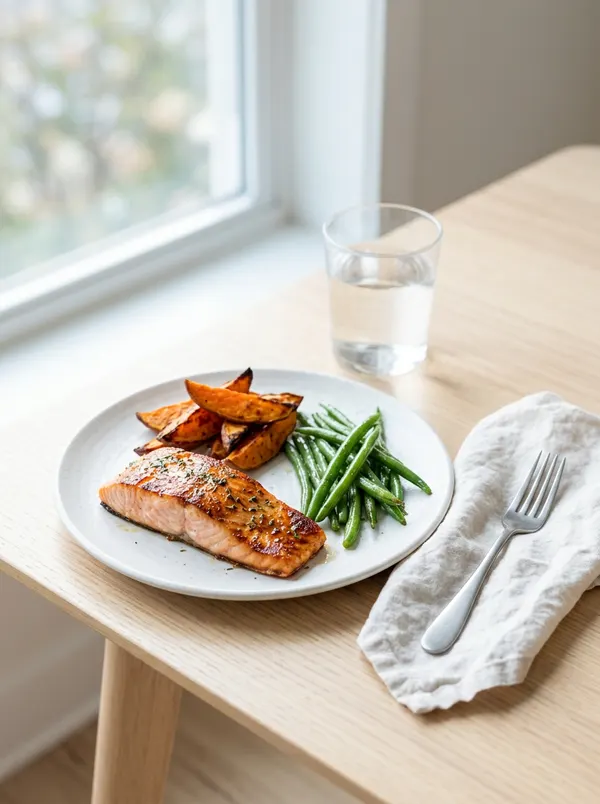
That’s the whole habit for a meal out: one photo and one answer, in a chat you already open every day. There’s no new app to install, and you can fix any entry later from the chat.
As of November 9, 2026, Getfiit costs $19.99 a month after a 3-day free trial, and you can cancel anytime. The how it works section on the home page shows the rest.
Frequently asked questions
Are restaurant calorie counts accurate?
Close on average, less so for single dishes. The 2011 JAMA study found stated and measured calories about 10 calories apart overall, but 19% of items held at least 100 calories more than stated. Items listed as lower in calories were more likely to be understated.
How do I track macros when eating out?
At a chain covered by the FDA rule, ask for the written nutrition information, which includes fat, carbohydrates and protein. Elsewhere, log the dish in parts. Protein is usually the easiest part to name, and the cooking fat is the one to add.
How do I count calories at restaurants with no menu numbers?
Log the dish in parts, as in Step 2, and add a line for the oil, butter or sauce, as in Step 3. When you’re unsure of the portion, pick the larger size.
How do I log a shared plate?
Log the whole dish, then your share as a rough fraction, such as half or a third. Don’t count bites. Being roughly right on the fraction is good enough.
What if tracking restaurant meals makes me anxious?
Tracking isn’t for everyone. If logging food makes eating out stressful, or you have a history of disordered eating, it’s fine to stop and talk to a doctor or a registered dietitian.
Your next step
Next time you eat out, try the five steps once. Check for posted calories, log the plate in parts, name the fat, pick the larger size if unsure, and log it before you get home. If you want the logging to take one photo, the how it works section shows what that looks like in WhatsApp.
This article is general information, not medical advice. Talk to a doctor or a registered dietitian before changing how you eat, especially if you have a health condition, are pregnant, or have a history of disordered eating.
Log your next meal in five seconds.
Getfiit is an AI nutrition coach that lives in WhatsApp. Send a photo, a voice note, or a text, and it replies with calories, macros, and what to do next.
Start on WhatsApp